

Email templater
Easy and intuitive to use The tool is designed to be simple and user-friendly, allowing you to quickly create and customize your email templates.
Accessing the email templater You can access the editor from Settings > General settings > Email template editor [Beta].
Template scopes
The platform manages two families of email templates, identified by their scope:
| Scope | Audience | Configuration level |
|---|---|---|
STOREFRONT | Customer-facing emails (order confirmations, account emails, quote notifications, etc.) | Per store and per locale |
BACK_OFFICE | Emails sent to Back Office users (export downloads, job failure notifications, logistic order confirmations, supplier quote updates) | Global to the platform |
Storefront templates
The 18 storefront templates are contextualized by store and locale: each template can have a different content and enabled/disabled state per store and per locale. See Email Localization for how the locale of an outgoing email is resolved.
Back Office templates
The 7 Back Office templates are available in the same editor:
| Template ID | Purpose |
|---|---|
product-export-download | Download link for a product export |
offer-export-download | Download link for an offer export |
order-export-success | Notification that an order export completed |
pay-export-download | Download link for a payment export |
new_job_execution_failed | Notification that a job execution failed |
logistic-order-confirmation | Confirmation of a logistic order |
update-supplier-quote | Notification that a supplier quote was updated |
Warning: Back Office templates are global to the platform. The template detail page hides the store and locale selectors, and both the enabled/disabled state and the content edits apply globally — there is no per-store or per-locale segmentation for these templates.
Default templates
Each store ships with default email templates built into the platform. When no custom template has been configured for an email, the default template is used as a fallback, so critical emails (order confirmations, account emails, etc.) are always sent.
Note: Default templates are being rolled out progressively. Contact DJUST to confirm availability on your environment.
flowchart LR
  %% Styles (Readme)
  classDef create   fill:#e8f1ff,stroke:#2f6feb,stroke-width:2px,color:#0b3d91;
  classDef read     fill:#ede9fe,stroke:#7c3aed,stroke-width:2px,color:#1e1b4b;
  classDef update   fill:#e0f7fa,stroke:#06b6d4,stroke-width:2px,color:#0c4a6e;
  classDef add      fill:#ecfdf5,stroke:#10b981,stroke-width:2px,color:#064e3b;
  classDef remove   fill:#fee2e2,stroke:#ef4444,stroke-width:2px,color:#7f1d1d;
  classDef decision fill:#fff4e5,stroke:#f59e0b,stroke-width:2px,color:#7a3e00;
  classDef place    fill:#dcfce7,stroke:#16a34a,stroke-width:2px,color:#14532d;
  classDef sys      fill:#f2f4f7,stroke:#475569,stroke-width:2px,color:#111827;
  classDef stop     fill:#fee2e2,stroke:#ef4444,stroke-width:2px,color:#7f1d1d;

  A[📧 Email event<br>triggered] --> B{Template<br>enabled}
  B -->|No| X[🚫 No email sent]
  B -->|Yes| C{Custom template<br>configured}
  C -->|Yes| D[🧾 Use custom<br>template]
  C -->|No| E[📘 Use default<br>template]
  D --> F[✅ Email sent]
  E --> F

  class A sys
  class B decision
  class C decision
  class D read
  class E read
  class F place
  class X stop
  style A rx:8,ry:8
  style D rx:8,ry:8
  style E rx:8,ry:8
  style F rx:8,ry:8
  style X rx:8,ry:8
Enabling and disabling templates
Each template can be enabled or disabled directly from the Back Office:
- Storefront templates — per template, per store, and per locale.
- Back Office templates — per template, globally.
A disabled template stops the corresponding email from being sent.
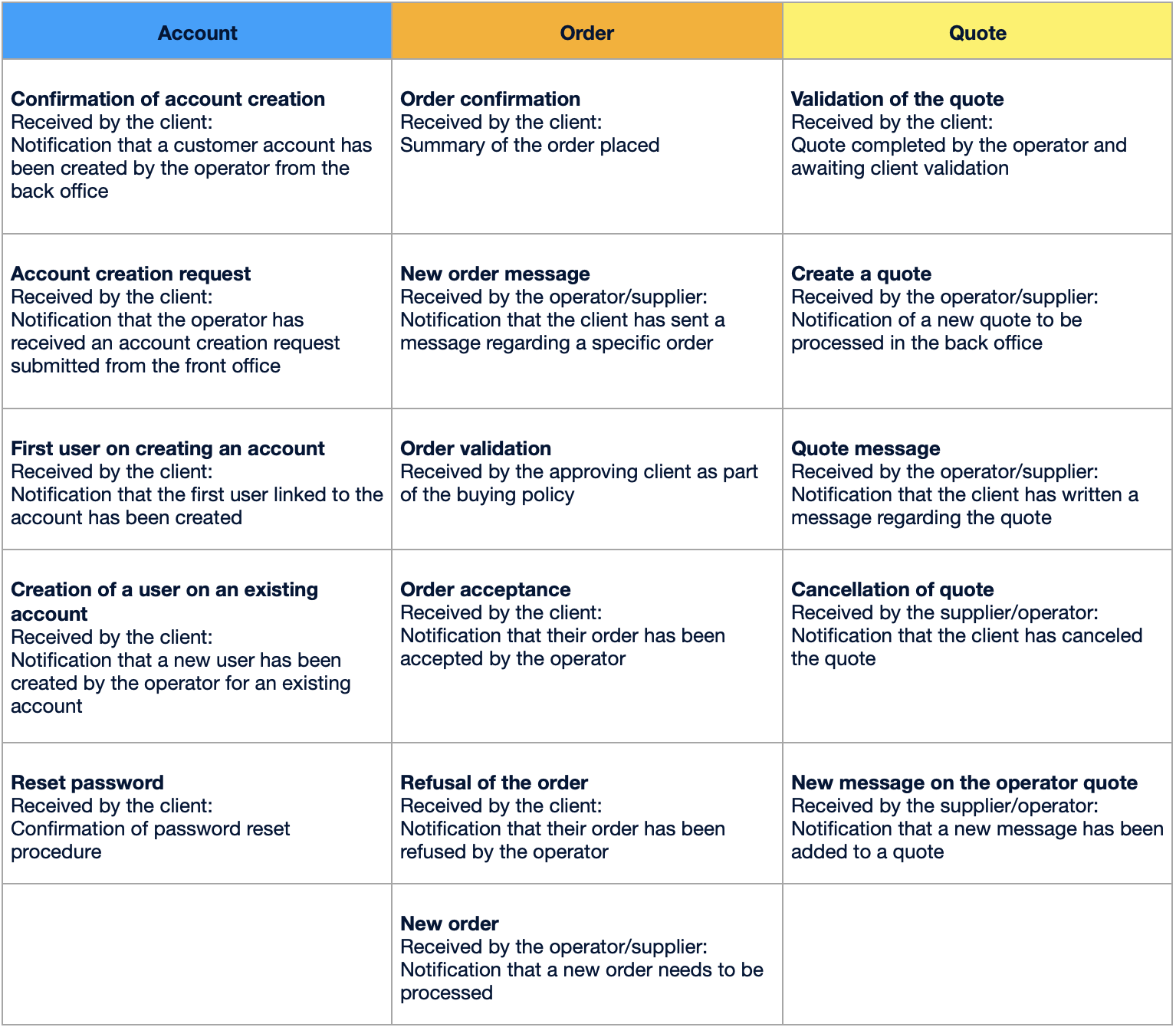
Email template categories All templates start as blank drafts. They are organized into four categories:
- All
- Account
- Order
- Quote
Page structure The email template editor is divided into five main sections:
- Settings
- Navigate between different emails
- Subject
- Enter the subject line of the email
- Additional recipients
- Manage CC and BCC recipients
- Variables
- Insert any of the available variables into the email you are creating
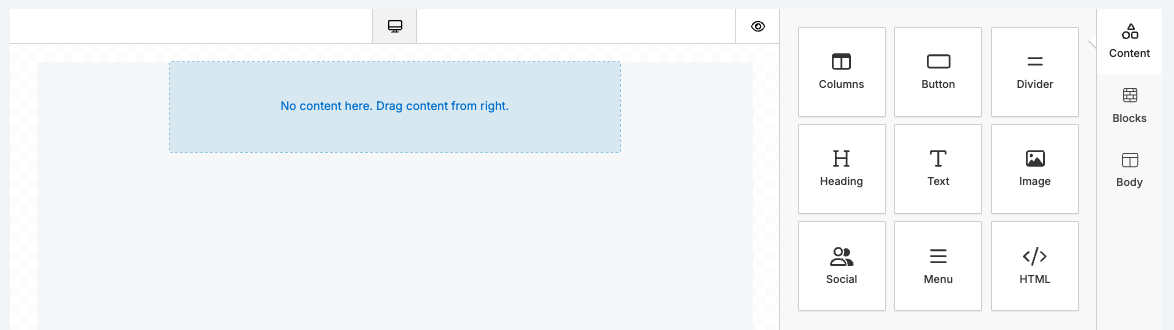
- Template editor
- On the left: the main preview area
- On the right: design options (heading, button, image, color, size, typography, etc.)
- Works with a drag-and-drop interface for easy customization
Managing templates via the API
Email templates can also be managed through the Admin API:
| Endpoint | operationId | Description |
|---|---|---|
GET /v1/mail-templates | getMailTemplates | List the mail templates |
GET /v1/mail-templates/{templateId} | getMailTemplate | Get a mail template |
GET /v1/mail-templates/{templateId}/content | getMailContent | Get the content of a mail template |
PATCH /v1/mail-templates/{templateId}/content | updateMailTemplate | Enable or disable a mail template |
POST /v1/mail-templates/{templateId}/content | createOrUpdateMailContent | Create or update the content of a mail template |
The template context returned by these endpoints carries a scope field (STOREFRONT or BACK_OFFICE).
{
  "id": "product-export-download",
  "name": "Product export download",
  "enabled": true,
  "scope": "BACK_OFFICE",
  "locales": [
    "en_US",
    "fr_FR"
  ],
  "mailTemplates": [
    {
      "locale": "en_US",
      "templateId": "product-export-download"
    }
  ]
}
Tip: Thescopefield is additive and backward compatible: existing integrations that ignore it keep working, and templates without ascopebehave as storefront templates.
Updated 2 months ago