

Stores
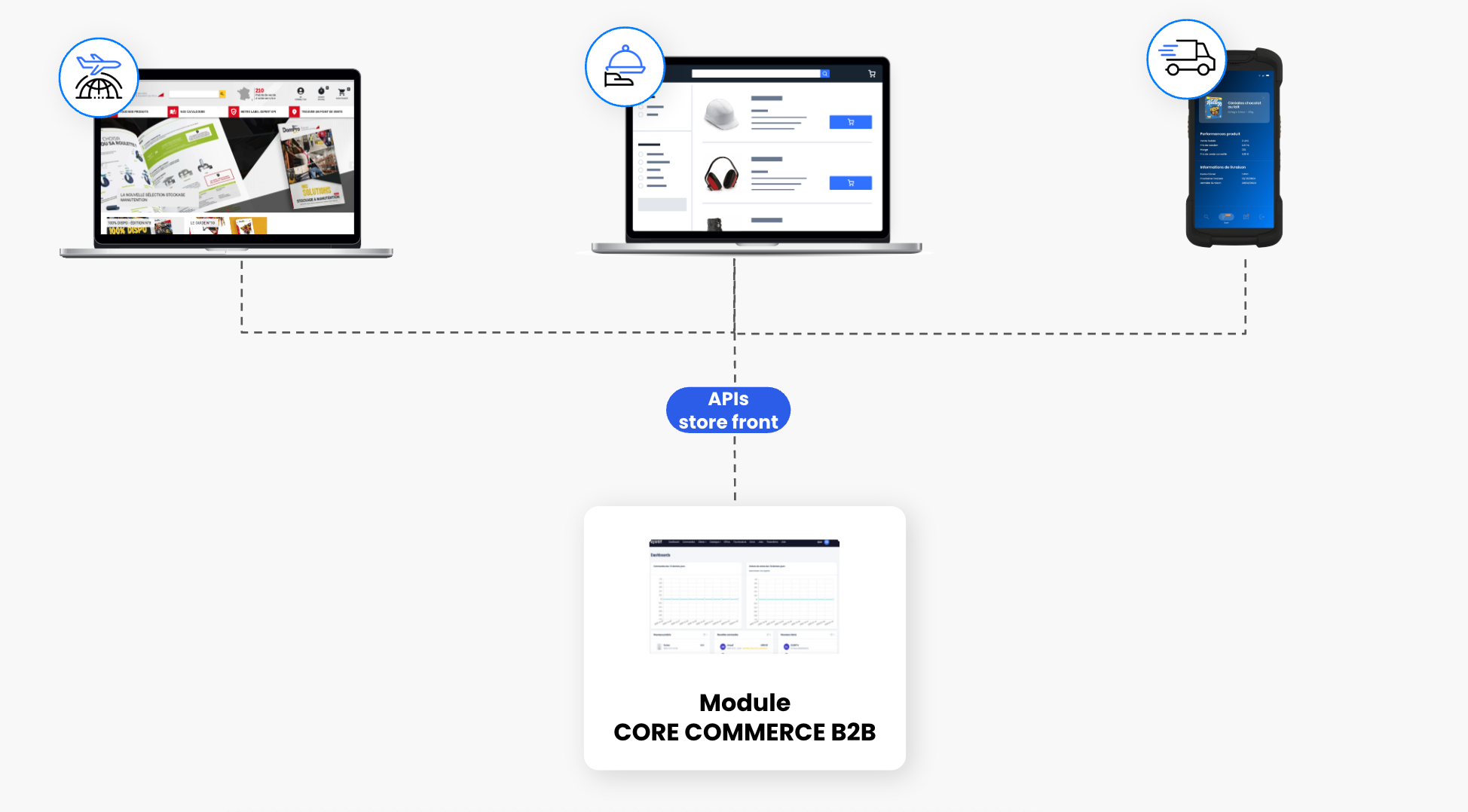
A store represents a subset of the DJUST platform that enables the management of multiple e-commerce sites or commercial divisions independently from a single back office.
It is used to segment products, users, and offers based on specific criteria.
A store can be used to manage:
- Different business entities (e.g., distinct brands, countries, or regions).
- Different customer personas (e.g., premium vs. basic, independents vs. retail chains).
Key Characteristics
- Your platform must be configured in multi-store mode in order to create and manage multiple stores.
- Each store is identified by a unique ID and has its own set of configuration parameters.
- A store allows you to:
- Customize the user experience based on commercial or regional context.
- Separate stock and offers based on defined rules (e.g., one store per country).
- Filter products and offers according to access rights and the organizational structure.
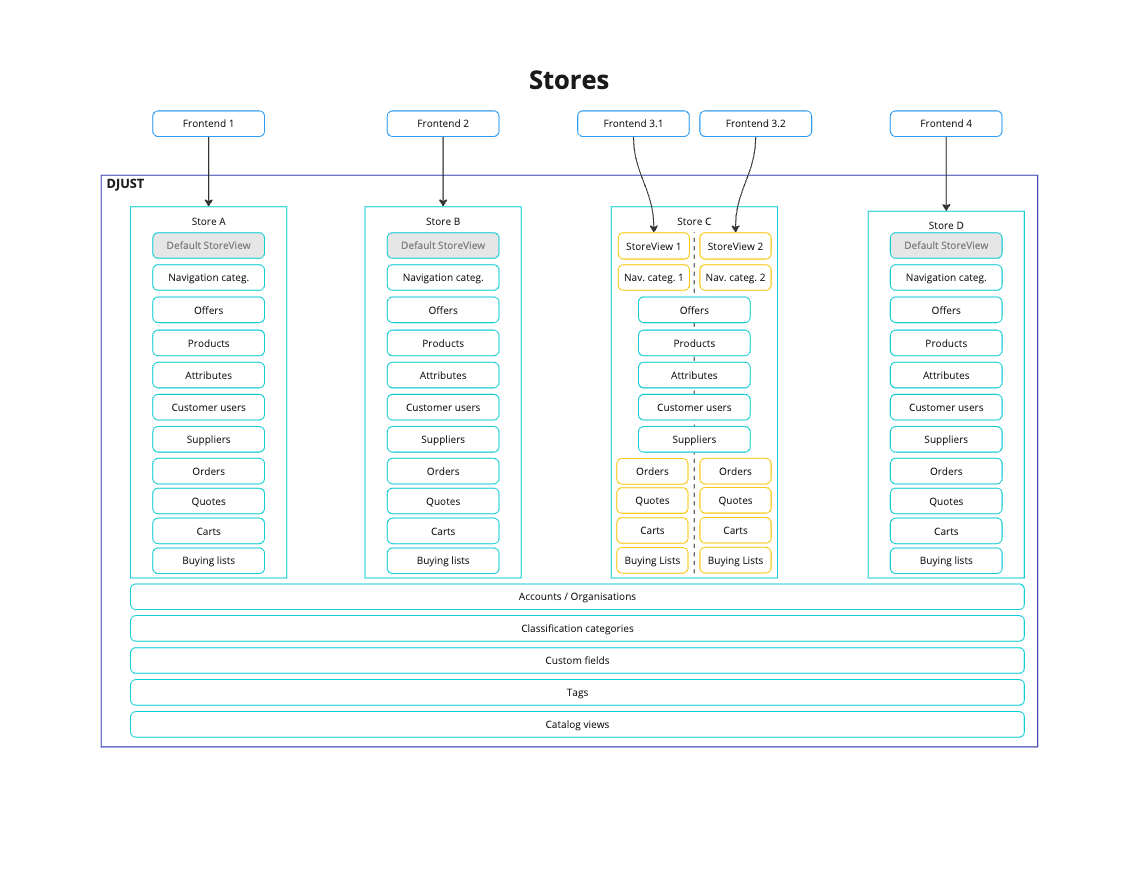
Some elements are shared across all stores, while others are store-specific:
Custom fields on a store
Custom fields can be attached to the STORE target to extend a store with your own business data (a country code, an ERP reference, a go-live date…).
Their values are consulted and edited directly from the store detail page in the Back-Office, in a dedicated section aligned with the one already available on accounts, users, suppliers, offers, orders and quotes. Each value is presented in the input matching its type: TEXT, LONG_TEXT, DATE, BOOLEAN, NUMBER, LIST_TEXT.
Behaviour to keep in mind:
- Clearing a value and saving deletes that value.
- Saving the form without touching the custom fields leaves the existing values untouched.
- If no custom field is configured on the
STOREtarget, the section is not displayed at all. - The rest of the store detail page — general information, store views, locales, tax mode — is unchanged.
On the API side, values are read and written through the customFieldValues field already exposed by the store contract. No dedicated endpoint is needed.
Tip: An integration can keep feeding store custom fields through the API, and an operator can still check or correct a value from the Back-Office without any technical intervention.
See Custom fields for how to create and configure them.
Updated 30 days ago